
Tariff News and Trade Intelligence™ | Career Chronicles™
Free weekly briefing
Know the tariff shift before it hits your bottom line.
Join procurement and supply chain leaders getting the Procurement and Tariff Intelligence Newsletter™ — concise, executive-ready briefings on tariffs, trade risk, and sourcing strategy from The Procurement Perspective™.
Free. Unsubscribe anytime. Delivered securely via Substack.An October 6 Refund Date, Up to 500% on Russian Goods, and a September 29 Ban on Canadian Dairy and Alcohol
Daily Tariff News and Trade Intelligence: Every Tariff Change September 22, 2026

Quick Answer: What Actually Changed on September 22?
The biggest change is a date: CBP will open CAPE Phase 3 on October 6, 2026 for a narrow group of older IEEPA refund claims.
- October 6 refund date: CBP will launch CAPE Phase 3 on October 6, 2026 for finally liquidated IEEPA entries covered by a Court of International Trade reliquidation order, starting with plaintiffs that filed a valid importer-of-record number by July 30.
- Up to 500% on Russian goods: H.R. 5334, signed September 18, 2026, directs duties of up to 500% on Russian goods and up to 100% on goods from named Russian-energy buyers by October 18, but no rates or country list have been published.
- Canada import ban: Specified Canadian dairy, alcoholic beverages, and motor-vehicle-related goods are barred from entry starting 12:01 a.m. ET September 29, 2026, while covered goods physically imported earlier stay at the 50% Section 338 duty.
- Pharmaceutical cutover: Section 232 duties on patented drugs extend to all remaining companies on September 29, 2026, at a 100% combined rate, while UK products sit at 0% additional under CBP guidance.
- China export permits: China added two drug-precursor chemicals to its export-permit list for the United States, Mexico, and Canada on September 22, 2026, which affects supply timing but not U.S. duty rates.
- New duty rates: Commerce set final freight rail coupler rates of 73.74% for the Czech Republic and producer-specific rates for India, and preliminary tris subsidy rates of 20.63% to 117.39% for China.
- Trade votes ahead: The USITC votes on van-type trailers on September 25, hydraulic cylinders on September 28, solar cells on October 14, and rail couplers on October 16, 2026.
- Confirmed vs. active investigation: A "Confirmed" tag means a rate, deadline, or legal action is in force or set by a published document; "Active investigation" means an agency is still gathering evidence toward a future decision.
- Watch: A development with no U.S. rate attached yet, logged so it does not surprise you later.
- Section 338: A 1930 trade law the United States is using to put a 50% duty, and now an import ban, on specified Canadian goods.
Jump to a Section
Every Tariff Change From September 22, 2026
Canada import ban starts September 29: the physical import date now decides whether goods get in at all
CONFIRMED | EFFECTIVE SEPTEMBER 29, 12:01 A.M. ETWhat happened
- Import prohibition: Beginning 12:01 a.m. ET on September 29, 2026, specified Canadian dairy products, alcoholic beverages, and motor-vehicle-related goods are excluded from entry into the United States under Section 338.
- Transition rule: Covered goods physically imported before the cutoff, but not yet entered or withdrawn from warehouse for consumption, stay under the existing 50% Section 338 duty instead of the ban.
- Separate from the 50% list: The ban is a second, narrower action. Canadian goods on the broader 50% list that are not on a prohibition annex keep entering at 50%.
Business consequence
For covered goods, this stops being a cost question. A shipment that crosses on September 28 is expensive. The same shipment crossing on September 29 is unavailable. Landed-cost models cannot fix an admissibility problem, so the control that matters is the physical import date, not the entry date and not the tariff rate.
Real-World Breakdown
Illustrative: $4,000,000 of covered Canadian product physically imported September 28 can still enter at the 50% Section 338 duty, or $2,000,000. The same product physically imported September 30 cannot enter at all, so the exposure becomes lost supply, expedited alternate freight, and customer shortfalls instead of a duty bill.
Procurement Action
- Give every Canadian-origin SKU on a prohibition annex a documented border-date decision: accelerate, cancel, or re-source.
- Capture HTS, legal origin, supplier, carrier, estimated border date, inventory runway, alternate source, and customer obligations on one line per PO.
- Escalate any load with a realistic chance of crossing on or after September 29.
| Date | 2026-09-29 |
| Event | Section 338 Canada import ban takes effect: specified alcoholic beverages, dairy products, and motor-vehicle-related goods |
| Program | Section 338 |
| Country | Canada |
| Impact Level | Critical |
| Status | Open |
| Owner | Trade Compliance |
| Notes | Already in your copy. Add: control on physical import date; pre-cutoff imports not yet entered stay at 50% |

Troutman Pepper Locke: From duties to import bans under Section 338
September 29 pharmaceutical tariff cutover: 100% is a combined rate, and the UK sits at 0%
CONFIRMED | EFFECTIVE SEPTEMBER 29, 12:01 A.M. ETWhat happened
- Who switches: Patented pharmaceutical products from companies outside the July 31 Annex III group begin Section 232 treatment on entries made on or after September 29, 2026. The temporary 0% code 9903.04.61 covers only entries before that date.
- How the 100% works: CBP describes 9903.04.60 as a 100% combined Column 1 plus Section 232 rate, not 100% added on top of the normal duty.
- Partner and UK rates: Qualifying products of the EU, Japan, South Korea, Switzerland, and Liechtenstein use 9903.04.62 at a 15% combined rate. CBP set UK products under 9903.04.63 at 0% additional, effective July 31, 2026 (CSMS #69415934).
- Generics: Generic pharmaceuticals and their associated ingredients remain at 0% additional Section 232 duty.
Business consequence
This is a supplier-level program. Two products under the same HTS code from the same country can land at different rates depending on the manufacturer, its agreements, and whether the drug is patented. The most common error to hunt for is stale 10% UK logic, which some tools still carry from before CBP's August 1 guidance.
Real-World Breakdown
Illustrative: $1,000,000 of a patented drug from a non-partner country with a Column 1 rate of Free lands at $1,000,000 in duty under the 100% combined rate. The same value of a qualifying UK product lands at $0 additional Section 232 duty. Loading 10% for the UK by mistake overstates cost by $100,000 on that line.
Procurement Action
- Complete a manufacturer-level rate matrix: legal manufacturer, site, HTS, origin, patented or generic, Chapter 99 heading, onshoring or pricing agreement, and importer of record.
- Search every rate table and ERP record for a 10% UK pharma rate and replace it with 0% additional.
- Confirm with the broker which Chapter 99 heading files on each line for entries on or after September 29.
| Product Category | Patented Pharmaceuticals & Ingredients (9903.04.60 / .62 / .63) |
| Applicable HTS Chapters | 29, 30 |
| Tariff Rate | 100% combined (.60); 15% combined (.62); 0% additional UK (.63) |
| Country Scope | All countries not covered by a partner rate or company agreement; generics 0% |
| Effective Date | 2026-07-31 (Annex III companies) / 2026-09-29 (all other companies) |
| Status | Active |
| Notes | Proc. 11020; CSMS #69395344 and #69415934. Remove any stale 10% UK logic |

CBP CSMS #69395344: Section 232 patented pharmaceuticals guidance
CBP CSMS #69415934: UK patented pharmaceuticals reduced to 0%
EU electrical steel safeguard lands September 25: why U.S. transformer buyers should watch it
CONFIRMED (EU MEASURE) | EFFECTIVE SEPTEMBER 25What happened
- What the EU did: The European Commission imposed provisional safeguards on grain-oriented electrical steel, laminations, and transformer cores, using tariff-rate quotas coupled with price thresholds.
- Unusual scope: The measure reaches cores already built into transformers, not just the steel itself.
- Timing: Measures apply from September 25, 2026, for a provisional period of up to 155 days.
Business consequence
No U.S. duty changes. The U.S. angle is supply. When Europe tightens quotas on electrical steel and cores, volume that can no longer enter the EU cheaply looks for other markets, and the U.S. is the obvious one. Transformer and core buyers can see price and lead-time moves in both directions: European transformer makers may raise prices, and Asian GOES or core volume may be offered more aggressively into U.S. supply chains.
Procurement Action
- If you buy transformers or cores made in the EU, ask suppliers whether the safeguard changes their input cost or delivery dates.
- Watch quotes from non-EU core and GOES suppliers for diverted volume, and confirm origin on anything that shifts.
- Keep the EU measure in a separate field from U.S. Section 232 steel treatment so neither gets double counted.
| Country | European Union (supplier market) |
| Product Category | Grain-oriented electrical steel, laminations, transformer cores |
| Tariff Rate (%) | No U.S. change; EU TRQ plus price threshold on imports into the EU |
| Tariff Source | European Commission provisional safeguard, effective September 25, 2026 |
| HTS Exclusion / Stacking Note | Track separately from U.S. Section 232 steel and derivative duties |
| Active Tariff Layers | U.S. layers unchanged; supplier cost watch only |

European Commission: provisional safeguard on grain-oriented electrical steel
Van-type trailer duties reach their final vote September 25
ACTIVE INVESTIGATION | FINAL VOTE SEPTEMBER 25What happened
- The vote: The U.S. International Trade Commission votes September 25, 2026, at 11:00 a.m. ET in the final phase of the cases on van-type trailers and subassemblies from Canada, China, and Mexico (Inv. 701-TA-780-782 and 731-TA-1767-1769). Results post at about 11:30 a.m. ET.
- What it decides: An affirmative injury vote clears the way for final duty orders. A negative vote ends the cases.
- China rates on file: Commerce's final China determination set a 130.76% adjusted antidumping cash-deposit rate for the China-wide entity.
Business consequence
Fleets, trailer dealers, logistics operators, and subassembly buyers all sit inside this. The key is separating finished trailers from covered subassemblies, and imported units from domestic inventory, before the vote, so the landed-cost update can go live the same day the result posts.
Procurement Action
- Map every trailer and subassembly supplier by producer, exporter, and country of origin.
- Separate finished trailers from subassemblies on open POs.
- Pre-build the landed-cost update so it can switch on at 11:30 a.m. ET September 25 if the vote is affirmative.
| Action | Map van-type trailer and subassembly suppliers by producer and origin ahead of the September 25 USITC final vote |
| Priority | High |
| Owner | Procurement |
| Due Date | 2026-09-24 |
| Status | Open |
| Notes | Canada, China, Mexico. China final adjusted AD deposit 130.76%. Landed-cost update ready to activate at 11:30 a.m. ET September 25 |

USITC: notational vote, van-type trailers and subassemblies, September 25
Hydraulic cylinder cases reach a preliminary vote September 28: allegations, not duties yet
ACTIVE INVESTIGATION | PRELIMINARY VOTE SEPTEMBER 28What happened
- The vote: The USITC votes September 28, 2026, at 11:00 a.m. ET in the preliminary phase of the investigations on linear hydraulic cylinders from Canada, China, India, Mexico, and South Korea.
- Scope of the cases: Antidumping investigations cover all five countries; countervailing duty investigations cover China, India, and Mexico.
- No payable rate: Petition dumping margins, which run as high as 744.85% for Canada, are allegations. Nothing is payable until Commerce issues preliminary determinations.
Business consequence
Cylinders are engineered parts. Switching suppliers means requalification, which takes months, not days. The time to line up an alternate is before a preliminary affirmative vote starts the clock toward cash deposits, not after.
Procurement Action
- Complete a producer-level exposure file for every cylinder part number: manufacturer, exporter, origin, equipment application, annual spend, and inventory runway.
- Ask current suppliers for requote scenarios and lead times in writing.
- Start engineering requalification on at least one alternate source for high-spend part numbers.
| SKU | Buyer-defined hydraulic cylinder part numbers |
| Product Category | Linear hydraulic cylinders |
| Vendor or Supplier Name | Current supplier per part number |
| Country | Canada / China / India / Mexico / South Korea |
| Impact Level | High |
| Lead Time (Days) | Include requalification time |
| Response Status | Requote requested before September 28 vote |

USITC: notational vote, linear hydraulic cylinders, September 28
Corrugated pizza box cases: appearance, testimony, and conference deadlines September 28 to 30
ACTIVE INVESTIGATION | CONFERENCE SEPTEMBER 30What happened
- Countries: China, Malaysia, and Türkiye.
- Deadlines: Requests to appear at the USITC preliminary conference are due September 28, 2026, at noon ET. Written testimony is due September 29 at 4:00 p.m. ET. The conference is September 30 at 9:30 a.m. ET.
- No duties yet: The preliminary injury determination follows in October. Nothing is payable now.
Business consequence
Restaurant chains, food distributors, and packaging buyers are the ones exposed. Participation is the lever here: an importer with a real stake can appear or file testimony, but only if it acts by the September 28 and 29 deadlines.
Procurement Action
- Decide by September 28 at noon whether to request an appearance.
- Pull pizza box spend by country of origin and converter.
- Ask domestic converters for capacity and pricing in case duties follow.
| Program | Corrugated Pizza Boxes AD/CVD Investigation |
| Country | China / Malaysia / Türkiye |
| Comment Due | 2026-09-29 (written testimony, 4:00 p.m. ET) |
| Hearing Date | 2026-09-30 (preliminary conference, 9:30 a.m. ET) |
| Status | Open |
| Submitted? | No |
| Notes | Appearance requests due September 28, noon ET |

USITC: preliminary conference, corrugated pizza boxes, September 30
Chromium trioxide from India and Türkiye: final hearing September 29
ACTIVE INVESTIGATION | HEARING SEPTEMBER 29What happened
- The hearing: The USITC holds its final-phase hearing September 29, 2026, at 9:30 a.m. ET in the antidumping and countervailing duty investigations on chromium trioxide from India and Türkiye.
- What follows: The final injury vote follows the hearing. Duty orders come only after an affirmative final vote.
Business consequence
Chromium trioxide feeds plating, surface treatment, and wood preservation. Buyers who source from India or Türkiye should know their current Column 1 rate, so they can measure the jump if orders issue.
Procurement Action
- Confirm the HTS code and current base rate for every chromium trioxide purchase.
- Identify each producer and exporter; AD/CVD rates are company-specific.
- Ask for pricing from a non-subject origin before the final vote.
| Country | India / Türkiye |
| Product Category | Chromium trioxide |
| HS Code | Buyer to confirm |
| Base Duty Rate (%) | Look up current Column 1 rate |
| Additional Duty Rate (%) | None payable yet; AD/CVD pending final vote |
| Tariff Program | AD/CVD investigation (final phase) |

USITC: hearing, chromium trioxide from India and Türkiye, September 29
UK Iran sanctions widen September 29: a screening issue for anyone buying from UK-linked suppliers
CONFIRMED (UK MEASURE) | EFFECTIVE SEPTEMBER 29What happened
- What the UK did: Expanded Iran trade restrictions take effect September 29, 2026, covering energy goods, precious metals, maritime equipment, natural gas, oil and petroleum products, petrochemicals, software, and technology.
- Reach: The rules extend to supply, delivery, third-country trade, technology transfers, and related services, plus expanded transport and financial restrictions.
Business consequence
No U.S. tariff changes. The exposure is counterparty risk. U.S. importers buying petrochemicals, energy products, or maritime equipment through UK traders, shippers, or insurers can find a supplier suddenly unable to perform, or a shipment held up by UK-side compliance checks.
Procurement Action
- Screen UK-based traders, shippers, and insurers in your petrochemical and energy supply chains against the September 29 changes.
- Ask UK counterparties to confirm in writing that no Iranian-origin inputs or services touch your orders.
- Line up a backup route for any shipment that depends on a UK intermediary.
| Product Name | Petrochemicals, energy products, and maritime equipment routed through UK intermediaries |
| Tariff Cost ($) | No change (sanctions screening issue, not a duty) |
| Risk Level | High |
| Suggested Mitigation | Keep the UK intermediary only with written sanctions confirmation by September 28; otherwise shift to a direct or non-UK route |
GOV.UK: Notice to exporters 2026/18, Iran sanctions amendments effective September 29
G20 trade ministers meet in Milwaukee September 30 to October 1
WATCH | SEPTEMBER 30 TO OCTOBER 1What happened
- The meeting: USTR hosts the G20 Trade Ministerial in Milwaukee, Wisconsin, September 30 to October 1, 2026.
- Agenda: USTR says talks will include forced-labor enforcement, the most-favored-nation principle, food-trade weaponization, and structural excess capacity.
Business consequence
Nothing binding is expected, but ministerials are where bilateral announcements tend to surface. The forced-labor and excess-capacity topics tie directly to tariff programs already in force, so a statement there can signal where the next actions go.
Procurement Action
- Assign someone to read the ministerial statement when it posts October 1.
- Note any country named alongside forced-labor or excess-capacity language.
| Event | G20 Trade Ministerial, Milwaukee, September 30 to October 1 |
| Why It Matters | Agenda covers forced-labor enforcement, MFN, and excess capacity, which link to active Section 301 programs |
| Procurement Question | Does the statement name any country or sector we source from? |
| Date Added | 2026-09-22 |

Lean beef quota: the September tranche closes September 30, the next opens October 1
CONFIRMED | TRANCHE CLOSES SEPTEMBER 30What happened
- The program: A proclamation signed in August expanded the lean beef trimmings tariff-rate quota by 100,000 metric tons per month for 90 days, starting September 1, 2026.
- Timing: The September tranche closes September 30 unless it fills earlier. The October tranche opens October 1, and the expanded window runs through November 30.
Business consequence
In-quota beef enters at the lower rate; anything past the quota pays the higher over-quota rate. Quota fills on a first-come basis, so timing a shipment into the right tranche is worth real money for processors and ground-beef buyers.
Procurement Action
- Confirm with the broker how much of the September tranche remains before routing late-September arrivals.
- Plan October arrivals to enter on or after October 1 if the September tranche is full.
- Record in-quota and over-quota rates separately in your rate table.
| HTS Number | Buyer-confirmed lean beef trimmings lines |
| Description | Lean beef trimmings |
| Special Rate Programs | Expanded TRQ: 100,000 t per month, September 1 to November 30, 2026 |
| Product Category | Meat |
| Section 301 | N |
| Section 232 | N |

White House fact sheet: further ensuring affordable beef
Customs user fees rise October 1: new MPF minimum $34.58, maximum $670.86
CONFIRMED | EFFECTIVE OCTOBER 1What happened
- What changes: CBP's fiscal year 2027 inflation adjustment raises the formal-entry Merchandise Processing Fee minimum to $34.58 and the maximum to $670.86, effective October 1, 2026.
- What stays: The 0.3464% ad valorem MPF rate is unchanged. Other COBRA user fees adjust too.
Business consequence
Small, but it touches every formal entry. Entries valued under about $9,983 pay the new minimum, and entries over about $193,666 hit the new cap. Landed-cost templates with hard-coded fee floors and ceilings will be wrong on October 1.
Real-World Breakdown
Illustrative: a $500,000 entry pays MPF at the $670.86 cap instead of $1,732 at the 0.3464% rate. A $5,000 entry pays the $34.58 minimum instead of $17.32.
Procurement Action
- Update MPF minimum and maximum in every landed-cost template and ERP fee table effective October 1.
- Ask the broker to confirm the new values on the first October entries.
| Date | 2026-10-01 |
| Event | CBP FY2027 customs user fee adjustment: MPF minimum $34.58, maximum $670.86 |
| Program | CBP / Fees |
| Country | Global |
| Impact Level | Low |
| Status | Open |
| Owner | Finance |
| Notes | 0.3464% MPF rate unchanged; update landed-cost templates |
Federal Register: customs user fees adjusted for inflation, FY2027
CAPE Phase 3 opens October 6 for older tariff refunds, but only for a narrow group of entries
CONFIRMED | LAUNCH OCTOBER 6What happened
- Launch date: CBP told the Court of International Trade it will deploy CAPE Phase 3 on October 6, 2026, in a declaration filed September 15.
- Which entries: Phase 3 covers finally liquidated entries that paid IEEPA duties and are covered by a Court of International Trade reliquidation order.
- Who files first: Plaintiffs that gave CBP a valid importer-of-record number by July 30, 2026 can file Phase 3 declarations at launch. Later submissions will get separate instructions.
Business consequence
This is not a reopening for every finally liquidated IEEPA entry. An importer with finally liquidated entries but no court order is still outside Phase 3. The risk is a finance team booking a receivable for entries that do not qualify, or missing the launch because ACE access and bank details were never set up.
Procurement Action
- Segment every IEEPA entry: current CAPE-eligible, Phase 3-eligible (finally liquidated with a CIT order), finally liquidated without an order, under protest, and certified but unpaid.
- For Phase 3 entries, confirm the importer-of-record number was on file with CBP by July 30.
- Verify ACE access and ACH refund details before October 6.
| CBP Entry No | One row per finally liquidated IEEPA entry |
| Program Type | IEEPA |
| Refund Route | CAPE Phase 3 |
| Liquidation Date | Final liquidation date from ACE |
| Deadline | 2026-10-06 (Phase 3 opens) |
| Memo Approved | Pending |
| Filing Status | Not Started |
| IEEPA? | Yes |
| Notes | Needs CIT reliquidation order and an IOR number filed with CBP by July 30, 2026 |

Mohawk Global: CBP to launch CAPE Phase 3 on October 6
Solar cells from India, Indonesia, and Laos: final injury vote October 14
ACTIVE INVESTIGATION | FINAL VOTE OCTOBER 14What happened
- The vote: The USITC votes October 14, 2026, on whether imports of crystalline silicon photovoltaic cells and modules from India, Indonesia, and Laos injure the U.S. industry.
- Commerce rates: Commerce already issued final affirmative AD/CVD determinations. Final AD rates include India 123.04%, Indonesia 94.36%, and Laos 65.43%.
- Last gate: The ITC vote is the final legal step before orders issue.
Business consequence
Solar developers and module buyers are the ones exposed. Rates are producer-specific and follow the cell's origin, not just where the module was assembled. A module built in a third country with Indian or Laotian cells can still be in scope.
Procurement Action
- Map every module to its cell producer and cell country of origin.
- Price an alternate-origin module for projects scheduled to import after October 14.
- Keep this AD/CVD case separate from the polysilicon Section 232 program that starts December 4.
| SKU | Buyer-defined module SKUs |
| Product Category | Crystalline silicon PV cells and modules |
| Country of Origin | India / Indonesia / Laos (cell origin) |
| Current Tariff Rate % | Producer-specific AD/CVD pending final ITC vote |
| Alt. Country of Origin | Non-subject cell origin |
| Recommended Action | Price alternate origin before October 14 |
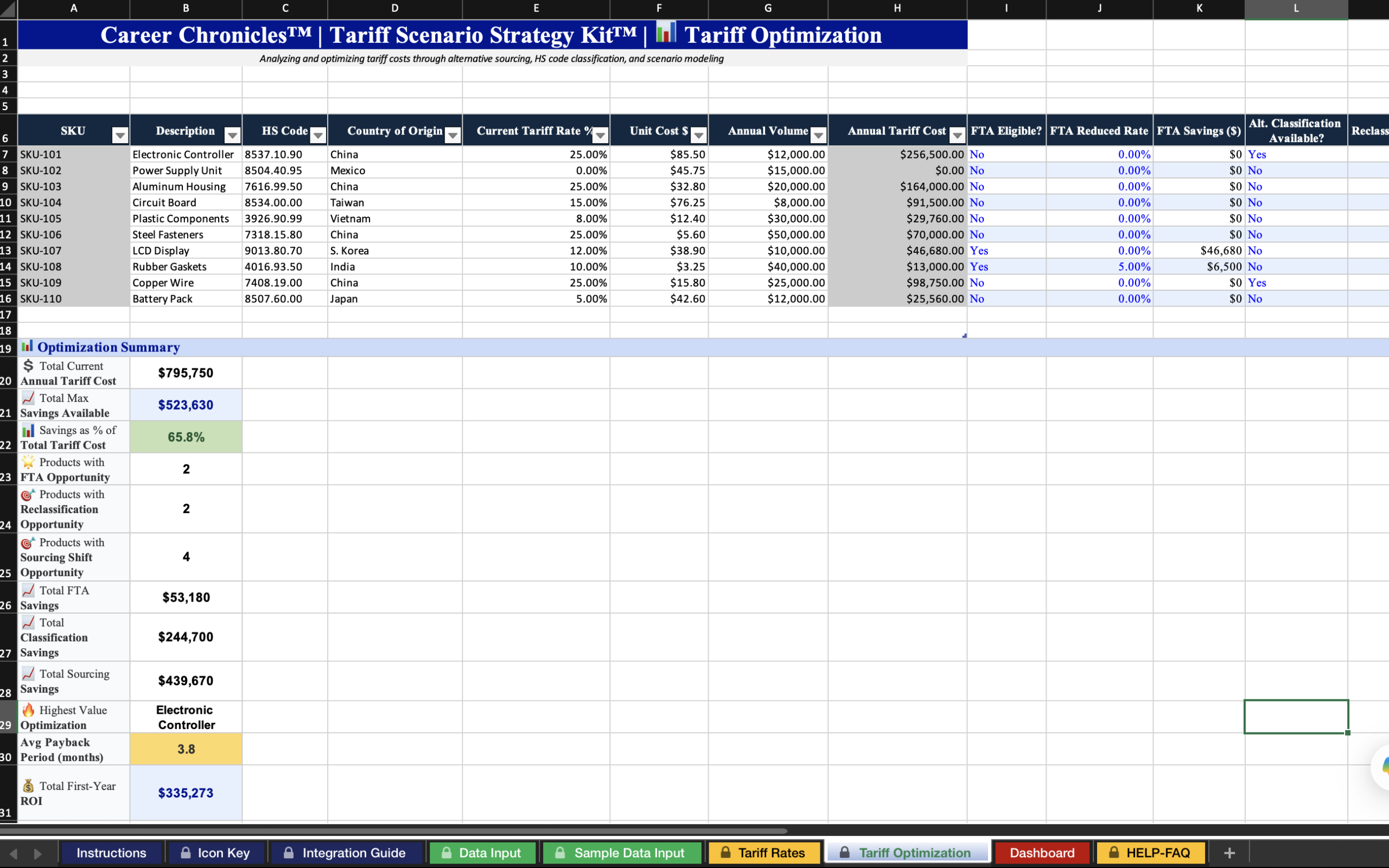
USITC: notational vote, crystalline silicon photovoltaic cells, October 14
Freight rail coupler duties are final at Commerce: up to 75% for some Indian producers, 73.74% for Czech
CONFIRMED (COMMERCE FINAL) | USITC VOTE OCTOBER 16What happened
- Czech Republic: Final antidumping rate of 73.74% for CKD Kutna Hora and all others.
- India: Adjusted antidumping cash deposits range from 0.00% (Kharagpur Metal Reforming) to 71.01% (Bhilai Engineering and Jupiter Wagons), with Texmaco at 12.10% and all others at 1.55%. Final CVD rates run from 9.71% to 75.00%.
- Next step: Commerce announced the finals September 21, 2026. The USITC final injury vote is October 16.
Business consequence
The spread between Indian producers is enormous, so a country average is useless here. The same coupler can carry a combined deposit under 10% or over 140% depending on who made it. Railcar builders and maintenance buyers need exposure by producer, not by country.
Real-World Breakdown
Illustrative: $1,500,000 a year in couplers from Texmaco carries a 12.10% AD deposit plus 75.00% CVD, or $1,306,500. The same spend with Kharagpur carries 0.00% AD plus 9.71% CVD, or $145,650. Same country, same product, a $1,160,850 gap.
Procurement Action
- List every coupler and part by manufacturer and exporter, not just country.
- Update landed cost using the producer-specific AD deposit plus the CVD rate.
- Line up an approved alternate supplier for high-rate producers before October 16.
| Country | India / Czech Republic |
| Product Category | Freight rail couplers and parts |
| HS Code | 8607.30.10 |
| Tariff Rate (%) | India: AD deposit 0.00%-71.01% plus CVD 9.71%-75.00%; Czech Republic: AD 73.74% |
| Tariff Source | Commerce final AD/CVD determinations, September 21, 2026 |
| HTS Exclusion / Stacking Note | Map to exporter; USITC final vote October 16 |

International Trade Administration: final determinations, freight rail couplers
Federal Register: coupler scope, HTSUS 8607.30.1010, .1050, .1090
Up to 500% on Russian goods: the Russia sanctions law's tariff clock runs out October 18
CONFIRMED LAW | RATES NOT YET PUBLISHEDWhat happened
- The law: The Lindsey O. Graham Sanctioning Russia and Iran Act of 2026 (H.R. 5334) was signed September 18, 2026.
- Section 112: Directs the President, within 30 days of enactment, to raise duties on all Russian-origin goods to a rate of up to 500%.
- Section 113: Directs duties of up to 100% on all goods from countries identified as major buyers of Russian energy or sanctions-evasion facilitators, reviewed every 180 days.
- Stacking: The law says these duties apply in addition to any other duty, including AD/CVD and Sections 122, 201, 232, and 301. No country list or implementing rate has been published.
Business consequence
The October 18 date is the statute's deadline, not a published rate. The biggest risk is not Russia, which most importers have already exited. It is Section 113: if a major sourcing country is named, its goods could carry up to 100% more, on top of everything else. That is a scenario to model, not an accrual to book.
Real-World Breakdown
Illustrative: $2,000,000 a year of goods from a country that is later named under Section 113 adds $500,000 at +25%, $1,000,000 at +50%, and $2,000,000 at +100%, before any other layer.
Procurement Action
- For any Russian content, model the 500% ceiling and plan an exit.
- For major Russian-energy-buying sourcing markets, run +25%, +50%, and +100% stress cases without labeling any country as covered.
- Build the stacking view now: base rate, Section 301, Section 232, AD/CVD, then the possible H.R. 5334 layer.
| Scenario ID | One per stress level |
| Country | Stress case only until a country list publishes |
| Tariff Rate (%) | +25% / +50% / +100% (Section 113); up to 500% (Section 112, Russia) |
| Tariff Scenario | H.R. 5334 implementation by October 18, 2026 |
| Impact Level (1-5) | Set from your own exposure |
| Response Strategy | Qualify second source; exit Russian content |
| Status | Under Review |

GovInfo: H.R. 5334 text
White House: H.R. 5334 signed into law September 18
India-New Zealand trade deal takes effect October 20: an origin check for U.S. buyers
WATCH | ENTRY INTO FORCE OCTOBER 20What happened
- The agreement: The India-New Zealand free trade agreement enters into force October 20, 2026.
- No U.S. rate change: It changes tariffs between India and New Zealand only.
Business consequence
It matters to U.S. buyers in one situation: a supplier in one country starts using inputs from the other because the agreement made them cheaper. U.S. duty follows where a good is substantially transformed, so a shift in a supplier's inputs can change the origin you declare.
Procurement Action
- Ask Indian and New Zealand suppliers whether they plan to change input sourcing after October 20.
- Re-check origin on any product whose bill of materials changes.
| Scenario | India-NZ input shift after October 20 |
| Tariff Multiplier | 1.00 (no U.S. change unless declared origin changes) |
| Unit Cost Multiplier | Set from supplier's revised quote |
| Volume Multiplier | 1.00 |
Comments on foreign trade barriers are due October 29
CONFIRMED | COMMENTS DUE OCTOBER 29What happened
- The request: USTR is taking comments for its 2027 National Trade Estimate report on foreign barriers that affect U.S. goods, services, and investment.
- Deadline: October 29, 2026, at 11:59 p.m. EDT.
Business consequence
This is a chance to put a specific foreign barrier on the record. It runs mostly through a company's export side, but procurement teams often know which foreign rules drive up costs in their supply chain.
Procurement Action
- Decide whether any foreign barrier you face is worth a submission.
- Coordinate with the export team so the company files once.
| Program | USTR 2027 National Trade Estimate Report |
| Country | Global |
| Comment Due | 2026-10-29 |
| Hearing Date | None |
| Status | Open |
| Submitted? | No |
| Notes | 11:59 p.m. EDT deadline |
Federal Register: request for comments, 2027 National Trade Estimate Report
China's November 10 deadline is really two separate projects
CONFIRMED | NOVEMBER 10 TRANSITIONWhat happened
- Product exclusions: USTR's 178 China Section 301 technology-transfer exclusions are extended through November 10, 2026.
- Maritime action: The China maritime, logistics, and shipbuilding Section 301 action was suspended for one year beginning November 10, 2025.
- No extension yet: The September 20 talks did not announce a formal extension of either one.
Business consequence
One is a merchandise duty question; the other is a freight cost question. Different owners, different data. If the exclusions lapse, excluded lines go back to their Section 301 rates. If the maritime suspension ends, fees tied to Chinese-built or Chinese-operated vessels can come back into freight costs.
Procurement Action
- Keep a merchandise file: SKU, HTS, exclusion number, underlying Section 301 rate, annual import value, alternate origin.
- Keep a separate maritime file: carrier, vessel builder, operator, route, and annual freight spend.
- Model both a lapse case and an extension case for each.
| Tariff Scenario | November 10 expiration of 178 Section 301 exclusions; maritime action suspension also ends that date absent extension |
| Impact Level (1-5) | Set from excluded-line value |
| Response Strategy | Model lapse and extension cases separately for duty and freight |
| Implementation Timeline | Before November 10, 2026 |
| Status | Under Review |

USTR: 178 Section 301 exclusions extended to November 10, 2026
Chinese tin mill products: 130.17% preliminary antidumping deposit, final decision by November 30
CONFIRMED (PRELIMINARY) | FINAL DUE NOVEMBER 30What happened
- Antidumping: Commerce's preliminary China-wide margin is 136.52%, with an adjusted cash-deposit rate of 130.17% after subsidy offsets.
- Countervailing duty: The companion case carries a preliminary 66.61% subsidy rate.
- Final date: Commerce will issue its final antidumping determination no later than 75 days after the September 16 signature, which is November 30, 2026. The CVD final is aligned with it.
Business consequence
Can and packaging makers are exposed, often without knowing it, because converters rarely disclose which mill made the steel. Adding the headline AD margin to the CVD rate overstates the deposit; the broker's cash-deposit instructions are what count.
Real-World Breakdown
Illustrative: $800,000 of Chinese tinplate at the 130.17% adjusted AD deposit plus 66.61% CVD carries $1,574,240 in deposits. Adding the 136.52% headline instead would overstate that by $50,800.
Procurement Action
- Require packaging converters to disclose the mill and exporter for tinplate and tin-free steel.
- Use the adjusted AD deposit plus the CVD rate, per the broker's instructions, not the headline margins.
- Qualify a non-China mill for high-volume can and closure lines.
| Vendor or Supplier Name | Packaging converter and upstream mill |
| Country | China (mill origin) |
| Tariff Risk | High |
| Active Tariff Layers | Preliminary AD 130.17% adjusted deposit + CVD 66.61% |
| Overall Risk | High |
| Mitigation Action | Require mill disclosure; qualify non-China mill before November 30 |

Federal Register: tin mill products from China, preliminary AD determination
Polysilicon price floors start December 4: $21 per kilogram up to $0.38 per watt for modules
CONFIRMED | EFFECTIVE DECEMBER 4What happened
- Minimum import prices: $21/kg for polysilicon, $100/kg for ingots and wafers, $0.22 per watt for cells, and $0.38 per watt for modules.
- Derivatives: Specified derivatives face a 15% Section 232 tariff. Japan, South Korea, Taiwan, Switzerland, Liechtenstein, and the EU get a 15% combined rate; the UK gets 10%.
- Effective date: Entries on or after 12:01 a.m. ET December 4, 2026. Importers must show the first arm's-length sale meets the floor, or that the purchase was under a contract signed before August 6, 2026.
Business consequence
This is a price-floor program, so the control is paperwork: PO price, entered value, first arm's-length U.S. sale, upstream origin, and pre-August 6 contract evidence. Solar and semiconductor buyers with contracts priced below the floors need a plan before December 4.
Procurement Action
- Compare every open polysilicon, wafer, cell, and module contract price against the floors.
- Pull and file pre-August 6 contract documentation now.
- Keep this Section 232 program separate from the solar AD/CVD case.
| Product Category | Polysilicon, ingots/wafers, cells, modules, specified derivatives |
| Tariff Rate (%) | Minimum import price program; 15% on specified derivatives (partner and UK rates differ) |
| Tariff Source | Section 232 proclamation, effective December 4, 2026 |
| HTS Exclusion / Stacking Note | Pre-August 6, 2026 contracts may qualify; separate from solar AD/CVD |
| Active Tariff Layers | Add Section 232 MIP layer effective December 4 |

Wiley: Section 232 tariffs and minimum import prices on polysilicon
Tris from China: preliminary subsidy duties of 20.63% to 117.39%
CONFIRMED (PRELIMINARY) | FINAL AROUND FEBRUARY 2, 2027What happened
- Rates: Commerce announced September 21, 2026 preliminary CVD rates of 117.39% for Changzhou Peicheng, 20.63% for Suzhou Yacoo, and 20.63% for all others on tris(hydroxymethyl)aminomethane from China.
- What's next: A companion antidumping case is running. Final AD and CVD determinations are expected on or around February 2, 2027, unless postponed.
Business consequence
Tris is a buffer used in pharma, biotech, and lab work. The rate depends on the exporter, so the 117.39% rate should not be applied to a supplier that qualifies for 20.63%. Cash deposits start once CBP instructions issue.
Real-World Breakdown
Illustrative: $400,000 a year of tris from Changzhou Peicheng carries a $469,560 deposit at 117.39%. The same volume at the 20.63% all-others rate carries $82,520.
Procurement Action
- Map every tris purchase to its producer and exporter.
- Confirm the scope covers your product and grade.
- Apply the correct company rate once CBP instructions take effect.
| Country | China |
| Product Category | Tris(hydroxymethyl)aminomethane |
| Additional Duty Rate (%) | Preliminary CVD: 117.39% (Changzhou Peicheng); 20.63% (Suzhou Yacoo and all others) |
| Tariff Program | CVD investigation (preliminary); AD investigation ongoing |

International Trade Administration: preliminary CVD, tris from China
Germany drug pricing hearing held September 22: still an investigation, no tariff
ACTIVE INVESTIGATION | HEARING SEPTEMBER 22What happened
- The hearing: USTR's Section 301 Committee held its public hearing September 22, 2026, at 10:00 a.m. ET at the USITC on Germany's pricing and reimbursement practices for innovative pharmaceuticals, including supplemental discounts and mandatory variable-rate rebates.
- Record: The hearing was not livestreamed. USTR says a transcript will be posted. It may continue September 23 if needed.
- Next deadline: Post-hearing rebuttal comments are due seven calendar days after the final hearing day.
- No rate: No Germany-specific tariff, product list, or effective date exists. This is separate from the Section 232 pharmaceutical program.
Business consequence
Nothing to accrue. The value is preparation: a Section 301 remedy against Germany, if one comes, would land on top of whatever Section 232 treatment German-origin patented drugs already carry. Teams that map German-origin exposure now can react in days instead of weeks.
Procurement Action
- Map German-origin patented drugs, APIs, and sole-source regulated inputs.
- For each, record alternate-source availability, qualification time, annual import value, and current Section 232 treatment.
- Mark the rebuttal deadline once the final hearing day is known.
| Program | Germany Pharma Section 301 |
| Country | Germany |
| Comment Due | 2026-08-10 (closed) |
| Hearing Date | 2026-09-22 |
| Status | Hearing held September 22; transcript pending |
| Submitted? | No |
| Notes | Already in your copy. Update Status; rebuttal due 7 calendar days after final hearing day |

USTR: public hearing, Germany pharmaceutical Section 301 investigation
Trump-Xi meeting September 24: a tariff-cut process exists, but no rate has changed
ACTIVE NEGOTIATION | MEETING SEPTEMBER 24What happened
- The visit: Xi Jinping's U.S. state visit runs September 23 to 25, 2026, with the main meeting September 24.
- Board of Trade: The September 20 Bessent and He Lifeng meeting agreed to run a Board of Trade process to identify a small set of non-strategic goods for possible tariff cuts. No products or rates were announced.
- Open items: Agriculture, energy, rare earths, aircraft purchases, technology, and the November truce deadline are all still being negotiated.
Business consequence
A summit statement is not a rate. Nothing about China-origin duties changes until a published notice and CBP instruction take effect. Teams that move rates on a headline end up reversing entries.
Procurement Action
- Keep current China tariffs in every system.
- Set up a change-control file: announcement, legal notice, CBP instruction, then the ERP change.
- Flag which of your China SKUs could plausibly be non-strategic candidates.
| Decision Point | Does the September 24 meeting produce a published Board of Trade product list and rate? |
| If YES | Model relief on listed SKUs once the notice and CBP instruction publish |
| If NO | Keep current China rates; move focus to the November 10 deadline |
| Best Path | Hold rates until legal implementation |
| Notes | Summit statement alone does not change landed cost |

White House: Xi Jinping state visit details
China adds 2 chemicals to its export-permit list for the U.S., Mexico, and Canada
CONFIRMED | EFFECTIVE SEPTEMBER 22What happened
- What China did: China's Ministry of Commerce and other agencies added two drug-precursor chemicals to the list that needs an export permit for shipments to the United States, Mexico, and Canada. The change took effect September 22, 2026, on release.
- List size: Exporters now need permits for 18 listed chemicals going to those three countries.
- Not a tariff: No U.S. duty changes. The timing, two days before the Trump-Xi meeting, reads as a negotiating signal.
Business consequence
Tariffs set the price of access. Export controls decide whether access happens at all. A chemical supplier can face no new U.S. duty and still be unable to ship without Beijing's permit, which turns the risk into days of lead time instead of percentage points.
Procurement Action
- Ask chemical, pharma, and specialty-material suppliers whether any input is on China's precursor list.
- Require written confirmation of permit status and expected lead time before confirming delivery dates.
- Add an 'export license required' field next to tariff and origin in your supplier file.
| Event | China adds 2 precursor chemicals to its export-permit list for the U.S., Mexico, and Canada (18 chemicals now require a permit) |
| Why It Matters | Supply can be gated by a Chinese export license even when the U.S. duty does not change |
| Procurement Question | Which suppliers rely on listed precursors, and have they confirmed permit status and lead time? |
| Date Added | 2026-09-22 |

Xinhua: China expands export control on precursor chemicals to U.S., Mexico, Canada
CBP opens Entry Type 13 for mail shipments of $2,500 or less
CONFIRMED | TEST BEGINS SEPTEMBER 22What happened
- What it is: A voluntary ACE test for an electronic informal entry for qualifying international mail shipments valued at $2,500 or less, deployed September 22, 2026.
- Data required: 10-digit HTSUS classification, origin, value, duty rate, total duty, importer information, and the postal tracking number.
- Exclusions: Shipments subject to AD/CVD or quotas are excluded and must use formal entry. Section 201, 232, and 301 duties can be handled, with added partner-agency data.
- Duration: No end date. The test runs until CBP announces its conclusion in the Federal Register.
Business consequence
Since de minimis ended, low-value mail imports need real entry data. This gives a cleaner electronic path for samples, spare parts, and small replenishment orders, but anything touching an AD/CVD order still needs formal entry.
Procurement Action
- List the SKUs you import by mail under $2,500.
- Flag any that fall under an AD/CVD order or quota, since those can't use Entry Type 13.
- Ask your broker or postal forwarder whether they will participate.
| Record ID | New |
| Product Name | Low-value mail shipments (samples, spares) under $2,500 |
| Impact Level | Low |
| Response Type | Process change: evaluate Entry Type 13 |
| Due Date | 2026-10-15 |
| Status | Open |

Federal Register: test of the new electronic informal entry process for mail
CBP CSMS #69289734: Entry Type 13 deploying to ACE production September 22
U.S.-Vietnam trade deal is close, but Section 301 is still inside the talks
ACTIVE NEGOTIATION | NO NEW RATEWhat happened
- The meeting: Vietnamese leader To Lam met USTR Jamieson Greer in New York, and both sides reported progress toward concluding a bilateral trade agreement.
- Open issue: Vietnam asked Washington to resolve issues tied to U.S. Section 301 investigations, including the intellectual-property investigation USTR opened May 29.
- No schedule: No revised tariff schedule or signing date has been announced.
Business consequence
Vietnam is where many China+1 moves landed. A deal could lower costs, but a Section 301 outcome could raise them, and nothing is legal until published. Awarding long-term volume on a concession that doesn't exist yet is the mistake to avoid.
Procurement Action
- Tag every Vietnam sourcing case that depends on the trade deal.
- Keep current Vietnam rates in your systems until a published schedule takes effect.
- Model a deal case and a Section 301 case side by side.
| Scenario | Vietnam: deal concluded / Section 301 IP remedy applied (two rows) |
| Tariff Multiplier | 1.00 held until a published schedule; set one row below 1.00 (deal) and one above (Section 301 remedy) |
| Unit Cost Multiplier | 1.00 |
| Volume Multiplier | Planned Vietnam share |
U.S. News (Reuters): Vietnam leader says positive negotiations with U.S. on trade deal
South Korea picks its first project under the $350 billion U.S. investment pledge
WATCH | FRAMEWORK UNCHANGED AT 15%What happened
- The project: South Korea selected a 6.3-gigawatt gas-fired power plant in Encinal, Texas, reported at more than $20 billion, as the first project under its $350 billion U.S. investment commitment.
- Why it matters: The commitment is tied to the trade framework that set U.S. tariffs on Korean goods at 15%.
- Still pending: The project needs U.S. government approval.
Business consequence
This lowers the risk that Washington raises Korean tariffs over slow investment, a threat made earlier. It does not change any rate. Keep Korean suppliers at the current framework rate and keep an execution-risk note alive until projects are approved and funded.
Procurement Action
- Keep Korean rates at the current 15% framework.
- Keep an execution-risk note on Korean strategic suppliers until approval and funding are confirmed.
| Event | South Korea selects first project (6.3 GW Texas gas plant) under $350B U.S. investment pledge |
| Why It Matters | Investment delivery is linked to keeping the 15% tariff framework |
| Procurement Question | Do any Korean strategic suppliers need an execution-risk note until approval? |
| Date Added | 2026-09-22 |
Korea Herald: Seoul picks Texas power plant as first project
EU and Philippines reach a trade deal covering more than 94% of tariff lines
WATCH | NOT YET IN FORCEWhat happened
- The deal: The EU and the Philippines reached substantial political agreement on a free trade agreement that would eliminate tariffs on more than 94% of tariff lines on both sides.
- Status: Legal text is still being written. It is not signed, ratified, or in force.
Business consequence
No U.S. tariff changes. The U.S. angle is competition for supply: if EU buyers get cheaper access to Philippine goods, Philippine suppliers may favor EU orders, and EU-made goods with Philippine inputs may get cheaper. Buyers with Philippine sourcing should watch allocation and pricing.
Procurement Action
- Note which Philippine suppliers also sell heavily into the EU.
- Watch for allocation or pricing changes once the agreement takes effect.
| Region | Southeast Asia (Philippines) |
| Current Tariff Rate % | No U.S. change |
| Proposed / Potential Rate | EU-Philippines FTA: not yet in force |
| Alternative Sources Available | Buyer to confirm |
| Recommended Action | Watch supplier allocation toward EU buyers |

Borderlex: EU and Philippines reach substantial deal on free trade pact
Canada says its ASEAN and Philippines trade talks are more than 90% done
WATCH | TARGET NOVEMBERWhat happened
- The talks: Canadian Trade Minister Maninder Sidhu said separate Canada-ASEAN and Canada-Philippines free trade negotiations are more than 90% complete.
- Target: Canada aims to finish both before Prime Minister Mark Carney's November visit to Manila.
Business consequence
Canada is working to sell more to Asia while its U.S. access narrows. For U.S. buyers, the issue is origin: Canadian materials moving through Asian suppliers are still Canadian-origin if they are not substantially transformed, which can trigger Section 338 duties or the September 29 ban.
Procurement Action
- Ask Southeast Asian suppliers whether they are adding Canadian inputs.
- Confirm substantial transformation on any product with Canadian content.
| Event | Canada-ASEAN and Canada-Philippines FTA talks over 90% complete; November target |
| Why It Matters | Canadian inputs routed through Asian suppliers can still carry Canadian origin |
| Procurement Question | Are any Southeast Asian suppliers adding Canadian content? |
| Date Added | 2026-09-22 |
BusinessWorld: Canada says Philippines, ASEAN trade talks 90% complete
Brazil holds off retaliating against U.S. tariffs while talks continue
WATCH | NO RETALIATION DATEWhat happened
- What Lula said: President Luiz Inácio Lula da Silva said Brazil will not invoke its reciprocity law against U.S. tariffs while bilateral negotiations continue.
- Change in status: Brazil had started the domestic process that could support countermeasures. That risk is now conditional on talks failing.
Business consequence
Retaliation hits U.S. exports, not imports, but companies that both buy from and sell to Brazil feel both sides. The U.S. 25% Brazil Section 301 duty stays in place either way.
Procurement Action
- Move Brazil retaliation from immediate risk to a conditional scenario.
- Keep the 25% Brazil Section 301 duty in current landed cost.
| Scenario | Brazil retaliation if talks fail (conditional) |
| Tariff Multiplier | 1.00 on U.S. imports (retaliation hits U.S. exports) |
| Unit Cost Multiplier | 1.00 |
| Volume Multiplier | 1.00 |
U.S. News (Reuters): Brazil to withhold reciprocity while talks continue
EU locks in duties of up to 192.2% on a Chinese water-treatment chemical
CONFIRMED (EU MEASURE) | EFFECTIVE SEPTEMBER 22What happened
- What the EU did: The EU imposed definitive antidumping duties on certain alkyl phosphonic acids and their sodium salts from China, a group used in water treatment and detergents.
- Rates: 156.7% to 192.2% for named producers, 173.8% for listed cooperating companies, and 192.2% for all other Chinese imports. Individual rates need the specified invoice certification.
Business consequence
No U.S. duty changes. When a major market shuts out Chinese product at rates this high, that volume looks for other buyers, and the U.S. is next in line. U.S. water-treatment and cleaning-chemical buyers may see cheaper Chinese offers, which can look like savings and later draw a U.S. trade case of their own.
Procurement Action
- Watch for unusually low Chinese quotes on phosphonate chemicals and document the source.
- Keep a non-China qualified supplier so a future U.S. case doesn't strand you.
| Country | China (supplier market) |
| Product Category | Alkyl phosphonic acids (PBTC and related) |
| Tariff Rate (%) | No U.S. change; EU definitive AD 156.7%-192.2% |
| HTS Exclusion / Stacking Note | Diversion watch: EU-blocked volume may be offered into the U.S. |
| Active Tariff Layers | Existing U.S. China layers only |

MLex: Chinese alkyl phosphonic acids face EU dumping duties
EU gives one Chinese fastener maker a 39.6% rate instead of 86.5%
CONFIRMED (EU MEASURE) | EFFECTIVE SEPTEMBER 22What happened
- What the EU did: The European Commission granted new-exporting-producer treatment to Carrey Intelligent Manufacturing (Jiashan) for certain iron and steel fasteners.
- Rate: Its antidumping rate becomes 39.6% under TARIC code 88FN, instead of the 86.5% China-wide rate.
Business consequence
No U.S. duty changes. It is a clean example of why producer-level data matters: one company's rate dropped by more than half while its neighbors stayed put. U.S. buyers of EU-made assemblies that use Chinese fasteners may see their suppliers' costs shift by producer.
Procurement Action
- Ask EU assembly suppliers which Chinese fastener makers they use.
- Record fastener sourcing by producer on any bill of materials you model.
| SKU | EU-made assemblies with Chinese fasteners |
| Product Category | Iron and steel fasteners (input) |
| Vendor or Supplier Name | EU assembly supplier |
| Country | EU (assembly) / China (fastener) |
| Impact Level | Low |
| Response Status | Ask which fastener producer is used |

EU starts registering Chinese alkaline batteries for possible back-dated duties
ACTIVE INVESTIGATION (EU) | REGISTRATION FROM SEPTEMBER 16What happened
- What the EU did: EU customs now registers imports of alkaline manganese dioxide primary cells and batteries from China.
- Why it matters: Registration lets the EU collect any final antidumping duty retroactively on registered entries. No duty rate has been set.
- Duration: Registration began September 16, 2026, and runs for nine months unless changed.
Business consequence
No U.S. duty changes. If the EU closes its market to cheap Chinese alkaline batteries, more of that volume will be offered to U.S. distributors and private-label buyers. That can lower prices briefly, and it can also draw U.S. attention.
Procurement Action
- Watch Chinese battery quotes for sudden price drops.
- Keep origin documentation clean for private-label battery lines.
| Event | EU registers Chinese alkaline battery imports for possible retroactive AD duties |
| Why It Matters | EU-blocked volume may be redirected to U.S. buyers |
| Procurement Question | Are our battery suppliers pricing differently since September 16? |
| Date Added | 2026-09-22 |
EU Law Live: Commission orders registration of Chinese alkaline battery imports
EU puts UK titanium dioxide under watch after a Chinese-owned group bought a UK plant
ACTIVE REVIEW (EU) | SURVEILLANCE FROM SEPTEMBER 19What happened
- What the EU did: The EU now tracks UK-origin titanium dioxide imports separately, after a Chinese-owned group acquired a UK production site.
- Why: The Commission wants to see whether EU antidumping duties on Chinese titanium dioxide, which run from €0.25 to €0.74 per kilogram, are being avoided through UK production.
- Status: Surveillance only. No new duty yet.
Business consequence
No U.S. duty changes. For U.S. paint, plastics, and coatings buyers, it's a reminder that ownership and origin are different questions. A UK-origin pigment from a Chinese-owned plant is UK-origin for U.S. customs if it is truly made there, but it can draw scrutiny.
Procurement Action
- Ask titanium dioxide suppliers for plant-level origin and ownership.
- Keep manufacturing documentation for any UK-origin pigment you import.
| Vendor or Supplier Name | Titanium dioxide supplier |
| Country | United Kingdom (plant) / China (owner) |
| Tariff Risk | Medium |
| Overall Risk | Medium |
| Mitigation Action | Collect plant-level origin and manufacturing records |

MLex: Titanium dioxide imports come under closer surveillance in EU
EU updates its dual-use export control list: chipmaking tools and advanced chips
WATCH | NOT YET IN FORCEWhat happened
- What the EU did: The European Commission adopted its annual update to the EU Dual-Use Control List, adding or revising controls on semiconductor manufacturing and test equipment, advanced computing chips, ceramic-matrix composites, and other technologies.
- Timing: It enters into force after a two-month Council and Parliament scrutiny period and publication in the Official Journal.
Business consequence
No U.S. duty changes. U.S. companies that buy European chip equipment, advanced components, or composite materials may need EU export licenses on their suppliers' side, which adds lead time.
Procurement Action
- Ask EU suppliers of chip equipment and advanced materials whether the update covers your orders.
- Build license lead time into delivery dates once the update takes effect.
| Product Name | Semiconductor tools, advanced ICs, ceramic-matrix composites from EU suppliers |
| Tariff Cost ($) | No change (export license issue) |
| Risk Level | Medium |
| Suggested Mitigation | Add EU license lead time to delivery dates once the update is published; identify a licensed-stock or non-EU source |
European Commission: 2026 update of the EU control list of dual-use items
China backs its automakers building in Europe as hybrids face pressure
WATCH | NO RATE CHANGEWhat happened
- What China said: Commerce Minister Wang Wentao said Beijing supports Chinese automakers investing in Europe and wants auto disputes settled through negotiation.
- The gap: EU duties of up to 35.3% apply to Chinese battery-electric vehicles. Plug-in hybrids are not covered by those duties, and the EU is pressing to limit them.
Business consequence
No U.S. duty changes. For U.S. parts and battery buyers, the takeaway is that brand and origin are separating. A Chinese-brand vehicle or component made in a European plant carries European origin, which changes how U.S. tariffs apply to it.
Procurement Action
- Track production location, not brand, for automotive parts and batteries.
- Note planned European start-of-production dates for Chinese-owned suppliers.
| Scenario | Chinese-owned auto supplier moves production to Europe |
| Tariff Multiplier | Set to the EU-origin rate once production moves (origin shifts from China to EU) |
| Unit Cost Multiplier | Set from supplier's European price |
| Volume Multiplier | Share moved to the European plant |
Investing.com (Reuters): China supports automaker investments in Europe
Canada 50% duty list still in effect after the September 15 rewrite: 122 codes added, 10 removed
CONFIRMED | IN EFFECT SINCE SEPTEMBER 15What happened
- Scope change: CBP added 122 HTSUS classifications to headings 9903.03.12 or 9903.03.14 and removed 10, effective 12:01 a.m. ET September 15, 2026 (CSMS #69851916).
- Rates: Headings 9903.03.12, .13, and .14 carry an additional 50%. Headings 9903.03.15 and .16 are 0%, and only goods under 9903.03.13 can still claim the .15 zero rate.
- Drawback: Section 338 duties under .12 to .14 are eligible for drawback.
Business consequence
This is a live cost, not a scenario. Entries on or after September 15 need to be reconciled line by line, especially any that used the zero-rate .15 pathway, which most goods lost.
Procurement Action
- Audit Canadian entries from September 15 forward: base HTS, Chapter 99 heading, scope change, Section 232 overlap, and AD/CVD.
- Re-check every line that claimed 9903.03.15.
- Open drawback for Section 338 goods that were re-exported or destroyed under CBP supervision.
| Country | Canada |
| Additional Duty Rate (%) | 50% (9903.03.12, .13, .14) |
| Tariff Program | Section 338 |
| Chapter 99 Code | 9903.03.12 / .13 / .14; zero rate .15 now for .13 goods only |
| Trade Agreement | USMCA does not exempt covered goods |
CBP CSMS #69851916: modifying Section 338 additional duties on goods of Canada
Canada's 15% to 50% counter-tariffs on U.S. goods are still in place
CONFIRMED (CANADA MEASURE) | IN EFFECT SINCE SEPTEMBER 8What happened
- What's in place: Canada imposes counter-tariffs of 15%, 25%, and 50% on C$27.6 billion of U.S.-origin goods, including steel and aluminum, dairy, appliances, farm equipment, pulp and paper, plastics, and electronics.
- Relief: Canada's remission process remains open for exceptional cases, such as inputs that can't be sourced in Canada or reasonably from non-U.S. sources.
Business consequence
This is Canada's tariff, paid by Canadian importers, so it hits U.S. companies that sell into Canada or run Canadian plants that buy U.S. inputs. Keep it separate from U.S. Section 338; they are different programs on different sides of the border.
Procurement Action
- Rank U.S.-origin goods your Canadian operations import by counter-tariff cost.
- For sole-source inputs, build a remission file now: classification, value, sourcing evidence, and outreach to other suppliers.
| Record ID | New |
| Product Name | U.S.-origin inputs imported by Canadian operations |
| Impact Level | High |
| Response Type | Prepare Canada remission request |
| Due Date | 2026-10-15 |
| Status | Open |

Department of Finance Canada: list of U.S. products subject to counter-tariffs
The 10% and 12.5% forced-labor tariff is the broad layer now; Section 122 is gone
CONFIRMED | SECTION 122 EXPIRED JULY 24What happened
- Forced-labor Section 301: USTR's final action covers 60 economies. Most get 10% or 12.5%, and certain goods from the EU, Taiwan, Japan, South Korea, and Switzerland use 10% or 12.5% net of the MFN rate. Product exemptions apply.
- Section 122: The 10% Section 122 surcharge ran 150 days from February 24, 2026 and expired July 24. It should not appear as an active layer in any tariff engine.
Business consequence
A tariff engine still stacking the old 10% Section 122 surcharge overstates cost on every line it touches. The fix is simple but has to be checked line by line.
Procurement Action
- Search tariff tables for any active Section 122 layer and remove it.
- Keep MFN, forced-labor Section 301, country-specific Section 301, Section 232, and AD/CVD in separate fields.
| Category | Legal Authority |
| Tariff Rate | 10% (expired) |
| Effective / Expiry | Feb 24, 2026 to Jul 24, 2026 |
| Status | Expired: remove from active stacking |
| Notes | Forced-labor Section 301 (10% / 12.5%) is the broad current layer |

USTR: fact sheet, Section 301 action on 60 economies
Brazil's separate 25% Section 301 tariff still applies
CONFIRMED | IN EFFECTWhat happened
- The action: USTR continues an additional 25% tariff on covered Brazilian goods, based on findings about digital trade and electronic payments, preferential tariffs, intellectual property, ethanol access, anti-corruption enforcement, and illegal deforestation.
- Separate layer: It sits apart from the forced-labor Section 301 program.
Business consequence
One Brazil rate does not fit every SKU. Each Brazilian line needs its own check for the Brazil-specific action, forced-labor treatment, exemptions, Section 232, and AD/CVD.
Procurement Action
- Validate each Brazil-origin SKU against the Brazil Section 301 product scope.
- Record the Brazil action and forced-labor treatment in separate fields.
| Country | Brazil |
| Additional Duty Rate (%) | 25% on covered products |
| Tariff Program | Section 301 (Brazil-specific) |
| Chapter 99 Code | 9903.05.01 |
USTR: Section 301 action on Brazil
USMCA still applies even though the July review didn't renew it
CONFIRMED | AGREEMENT IN FORCEWhat happened
- Status: At the July 1 joint review, the United States declined to renew USMCA in its current form. USTR says the agreement remains in force while negotiations continue.
- Focus areas: Talks with Mexico have covered auto rules of origin, steel and aluminum, economic security, and third-country inputs.
Business consequence
Do not strip USMCA preference from qualified entries because renewal was withheld. The agreement still applies; what may change later is the rules.
Procurement Action
- Keep current USMCA qualification on qualified entries.
- Track possible rule changes in a separate future-review field.
| Event | USMCA remains in force after the July 1 review withheld renewal |
| Why It Matters | Preference still applies; future rule changes for autos, steel, and aluminum are under negotiation |
| Procurement Question | Are we still claiming USMCA on every qualified entry? |
| Date Added | 2026-09-22 |
USTR: Ambassador Greer statement on the USMCA joint review
Hormuz: Iran offers to reopen within 7 days, but only 2 commodity ships crossed September 21
ACTIVE DISRUPTION | NOT A TARIFFWhat happened
- The offer: Iran said it could reopen the Strait of Hormuz within seven days if the United States eases military pressure and lifts the blockade on Iranian ports. It is a proposal, not an agreement.
- Partial recovery: Saudi Arabia restarted its East-West pipeline at a reduced rate after the September 13 drone attack. Brent fell below $100.
- Still severe: Preliminary data showed two commodity vessels crossing Hormuz on September 21, and two vessels were struck in separate incidents.
Business consequence
A lower oil price doesn't mean shipping is back. Freight, war-risk insurance, rerouting, and fuel costs remain high for anything moving through the Gulf. Keep those costs apart from customs duty so neither hides the other.
Procurement Action
- Keep Gulf contingency assumptions until vessel traffic recovers.
- Track freight, bunker fuel, war-risk and cargo insurance, rerouting, and emergency inventory as separate cost fields.
- Require vessel, carrier, insurer, route, and ETA confirmation for critical Gulf-linked shipments.
| Product Name | Petrochemicals, fuels, fertilizers, and Gulf-routed freight |
| Tariff Cost ($) | No change (freight, fuel, and insurance cost, not duty) |
| Risk Level | High |
| Suggested Mitigation | Hold Gulf contingency until vessel traffic recovers; price a non-Gulf source or reroute |
CNBC: Iran says it can reopen Strait of Hormuz within 7 days
What to Do Before September 29
- Decide every Canadian load by physical import date: covered goods crossing on or after 12:01 a.m. ET September 29 cannot enter. Accelerate, cancel, or re-source now.
- Fix the pharma rate table: 100% is a combined rate under 9903.04.60, qualifying partner products are 15% combined, and UK products are 0% additional. Remove any 10% UK logic.
- Get ready for October 6: sort IEEPA entries into Phase 3-eligible and not eligible, and confirm ACE access and ACH details.
- Model H.R. 5334 without booking it: run +25%, +50%, and +100% cases for sourcing countries that buy Russian energy, and plan an exit from any Russian content.
- Map producers, not countries: rail couplers, tris, and tin mill rates all swing by manufacturer.
Quick questions, plain answers
Does CAPE Phase 3 on October 6 reopen refunds for every finally liquidated IEEPA entry?
No. CBP told the Court of International Trade that Phase 3 covers finally liquidated entries covered by a Court of International Trade reliquidation order. Plaintiffs that gave CBP a valid importer-of-record number by July 30, 2026 can file at launch on October 6, 2026; later submissions get separate instructions.
Is there a 500% tariff on Russian goods right now?
No. H.R. 5334, signed September 18, 2026, directs the President to raise duties on Russian goods to a rate of up to 500%, and on goods from countries named as major buyers of Russian energy to up to 100%, within 30 days. No implementing rate or country list has been published, so there is nothing to accrue yet.
What happens to covered Canadian goods that arrive before the September 29 ban?
Covered goods physically imported before 12:01 a.m. ET on September 29, 2026, but not yet entered or withdrawn from warehouse for consumption, stay under the 50% Section 338 duty instead of the import prohibition. Covered goods imported on or after that time are excluded from entry.
What is the Section 232 rate on patented pharmaceuticals from the UK?
0% additional. CBP guidance CSMS #69415934 set UK products under heading 9903.04.63 at 0% additional Section 232 duty, effective July 31, 2026, replacing the earlier 10% rate.
Is the 100% pharmaceutical tariff added on top of the normal duty?
No. CBP describes heading 9903.04.60 as a 100% combined rate that includes the Column 1 duty and the Section 232 duty together. Qualifying EU, Japan, South Korea, Switzerland, and Liechtenstein products use a 15% combined rate under 9903.04.62.
Does China's new export-permit rule on precursor chemicals change U.S. tariffs?
No. China added two drug-precursor chemicals to its export-permit list for the United States, Mexico, and Canada, effective September 22, 2026. It is an export control that can affect supply and lead time, not a U.S. customs duty.
Six decisions for the operating team
- Trade compliance: Confirm the Chapter 99 heading on every patented pharmaceutical line entered on or after September 29, and set UK products to 0% additional.
- Procurement: Give every Canadian-origin SKU on a prohibition annex a documented border-date decision before September 29.
- Finance: Book CAPE Phase 3 receivables only for finally liquidated entries covered by a court reliquidation order, and do not accrue any H.R. 5334 rate until one is published.
- Customs broker: Update the merchandise processing fee minimum to $34.58 and maximum to $670.86 for entries on or after October 1.
- Supplier management: Collect producer and exporter names for rail couplers, tris, tin mill steel, and hydraulic cylinders, because the duty depends on the company.
- Leadership: Keep summit statements, negotiations, and enacted-but-unimplemented laws out of landed cost until a published notice and CBP instruction take effect.
Editorial note: every story above was cross-checked against the live TOS product workbooks (the 90-Day Tariff Risk Calendar, US Tariff Rate Lookup, Tariff Playbook Suite, Tariff Auto-Fill Tool, Tariff Refund Suite, Tariff Impact Automation Suite, Tariff Scenario Strategy Kit, Strategic Command Suite, and Tariff Defense Masterplan), and the conflicting items in the underlying research were checked against the issuing government source before publication.
Career Chronicles Procurement Intelligence Tools Recognized by Industry Publications
Career Chronicles procurement and tariff intelligence tools have been recognized and featured in independent publications and industry research platforms for their accuracy, timeliness, and strategic value to procurement professionals.


Never Miss a Tariff Change
New tariff and trade-remedy developments land daily, sometimes overnight, the way the October 6 CAPE Phase 3 launch date did. Subscribe for the daily briefing, the weekday podcast, and every tracker update, delivered as soon as it's verified against the actual product workbooks.
Find the daily briefing everywhere: the newsletter and full article at CareerChronicles.org, the weekday podcast on Substack, and daily updates on LinkedIn.
Get Procurement & Tariff Intelligence by Email
The Tariff Operating System™
Start with a free resource or select a complete toolkit. Every tool below reads the same underlying structure, so the work you do in one carries into the next. You pay once. Every update after that, including this one, is included.
 90-Day Tariff Risk Calendar™ Free Track critical tariff deadlines, comment periods, refund windows, and team actions in a practical 90-day dashboard. Get Free Access →
 US Tariff Rate Lookup Free Look up current US tariff rates by HS code and country, with a free companion tariff-rate export. Get Free Access →
 Tariff Auto-Fill Tool™ $97 Auto-populate HS codes, duty rates, and landed-cost estimates across your product catalog, including Section 301 and 232 overlays. View Checkout →
 Tariff Playbook Suite™ $27 Plug-and-play calculators, checklists, and action plans, with 60+ live formulas and auto-calculating dashboards. View Checkout →
 Fast Track Executive Briefing Kit™ $19 Executive-ready templates, calculator, and slide deck to communicate tariff impact to leadership fast. View Checkout →
 Tariff Refund Suite™ $197 Templates, trackers, and step-by-step guides to file CBP protests and claim tariff refunds and duty drawback. View Checkout →
 Tariff Impact Automation Suite™ $199 Excel dashboards, supplier-risk alerts, and scenario planners for tariff cost tracking and sourcing decisions. View Checkout →
 Tariff Scenario Strategy Kit™ $449 Premium scenario modeling with scoring, automation, and an integrated duty-drawback calculator. View Checkout →
 Strategic Command Suite™ $849 Scenario planning, boardroom briefing, and supply-chain tools for advanced tariff strategy and communication. View Checkout →
 Tariff Defense Masterplan™ $1,299 Enterprise dashboards, strategy, automation, and executive deliverables for tariff risk, compliance, and crisis management. View Checkout →
NewsLetter and official Channels

Official Substack Publications
- https://ramiekvirk.substack.com/
- https://ramiekvirk.substack.com/s/procurement-perspective
- https://ramiekvirk.substack.com/s/founder-notes-building-the-voice
Official Linkedin
Official Medium Publications
Official Youtube Channels: